Getting her breath back
December 4, 2025
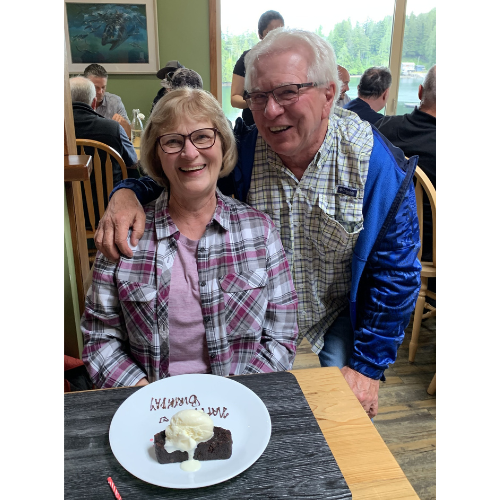
Eleanor and her husband, Barry, celebrate her birthday.
Eleanor Nolt was out for a walk with her husband, Barry, near their cabin in Jasper, Alta. Suddenly she had to stop to catch her breath. Yet they were on flat ground.
She thought maybe the chilly March weather was making her short of breath. But that night, she woke up with racing heartbeats. “Everything felt like it was shaking, and I realized, oh, it's my heart.”
Back home in Edmonton, Eleanor made an appointment with her family doctor. Eight years earlier, the doctor had detected a faint murmur while listening to her heart. This led to a diagnosis of mild stenosis in her aortic valve. Since then, Eleanor had been seeing a cardiologist every one to two years, to monitor her valve.
Now, after tests including an echocardiogram, Eleanor got a call from the doctor. “Are you sitting down?” she said. “You have severe aortic stenosis, and you will probably need surgery.”
Eleanor, now 73, shared her story with Heart Valve Voice.
How did the initial diagnosis of mild aortic stenosis affect your life?
Not a lot at first. At my first appointment with the cardiologist back in 2013, he said I would need a valve replacement in 10 or 15 years, but meanwhile I shouldn’t worry about it.
After that, I went for tests every year or two years. Each time they said everything was the same, no change. Basically, “You’re fine, you’re great.”
Looking back now, I realize that I had started to experience some shortness of breath. For example, before I retired in 2017, I would take the stairs at work up to my office on the second floor. Sometimes I'd have to step to the side so other people could pass me because I was out of breath.
I remember thinking, “I am out of shape! I’ve got to work out harder.” It was only later that I realized my heart was not functioning properly.
What happened after your aortic stenosis became severe?
I received that diagnosis in spring 2021. It was the middle of COVID. The cardiologist sent me for an angiogram but it ended up taking several months to get the test.
In the meantime, my family doctor urged me to take it easy. “Don’t stress yourself. If you’re walking and you're out of breath, just stop and catch your breath,” she said. I finally had the angiogram in July. It showed I had no other blockages in my heart, so everything was good for surgery.
By this time, I couldn't walk upstairs without stopping two or three times. We’d still go for a walk every day, but I had to stop frequently. Meanwhile, again because of COVID, the surgery was cancelled and rescheduled several times.
How did you cope with that wait for surgery?
I was scared that I was not going to get this surgery and that I wasn’t going to make it. I had tears quite a few times. It was a stressful time for my family.
I couldn't go anywhere. They told me to stay away from people, because they didn't want me to get COVID. Meanwhile my shortness of breath was getting worse. And sometimes during the night, my heart would flutter and wake me up.
I did lots of deep breathing. That helped. And I kept doing exercises to make sure my core would be strong enough after the surgery.
You finally had valve replacement surgery. How did it go?
It was Oct. 7, 2021. That’s the first time I met my surgeon. He talked to me for about an hour before the operation. That’s also when I learned that I had a bicuspid aortic valve; I was born with two leaflets instead of three.
He recommended a tissue replacement valve because I was still young — in his words — and active. I agreed because I knew that if I got a mechanical valve, I would be on blood thinners for the rest of my life. With the tissue valve, I would just take a baby Aspirin daily.
He explained the operation, that he would open up my chest. And he said the recovery would take three months or so. He said, “We’ll walk you through it, and we'll give you instructions on what to do and what not to do.”
My surgeon was excellent. After the operation, my progress was really good. They told me I'd be in hospital about seven days, but I went home after four.
How was your recovery?
I had lots of help at home. My husband was working, but my sister and brother-in-law would stay with me during the day, and my two sisters-in-law and friends helped me a lot as well. My two daughters came often. I was up walking every day around the house, then outside with my walker. Every day I tried to go a little bit further — once around the block, twice around the block.
Then after about six weeks, I started cardiac rehabilitation. It was virtual, on Zoom. I would put my computer on the couch so they could see me doing the exercises. The program was good, including a session on nutrition. It was helpful to hear some of the questions that other people were asking.
It was about six months before I really felt healed. By then I was able to do a lot more things than I could do before.
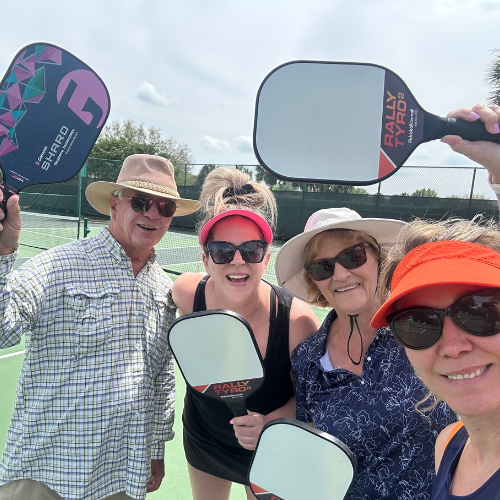
Eleanor and Barry with their two daughters.
How are you doing today?
Great! It’s more than four years since the operation. I’m really doing better than before, because in the last year and a half before surgery, I was going downhill and didn't even realize it.
I go to aquafit three times a week. I do some yoga, and I walk three kilometres every day. I also look after the grandkids once in a while, and we socialize regularly with a group of friends.
We were told I will probably need another valve in about 10 years. They should be able to insert another valve using a non-invasive procedure.
What advice would you have for someone facing a diagnosis of aortic stenosis?
I wish I’d known how serious aortic stenosis is. At my first appointment with the cardiologist back in 2013, he said there was no point in worrying while surgery was many years away. So, in my mind, it sort of became no big deal. But it turned out to be a big deal.
I would say to pay attention to shortness of breath. I didn't realize that was such an important symptom. I would also say to do what your doctor tells you to do.
Finally, it’s important to accept help from family members and friends. After my surgery, we relied on that. There was stuff I could not do. For example, one day I tried to open the fridge door, and I couldn't do it without getting pain in my chest. That's the kind of thing you don't even think of. For the first six weeks, especially, you need a lot of support.