
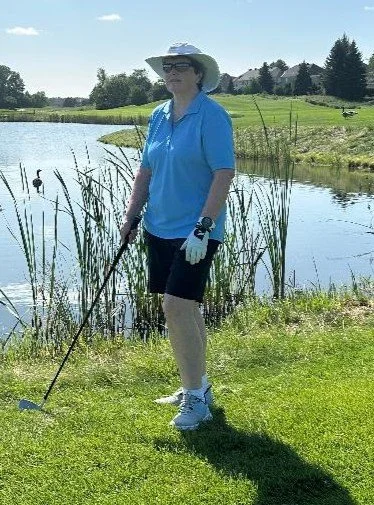
After treatment, Ann Mitchell has more energy for golf.
When Ann Mitchell learned she needed open-heart surgery to replace her aortic valve, it wasn’t a surprise. The retired nurse, now 63, had been diagnosed years earlier with a rare quadricuspid aortic valve, which had four leaflets instead of the usual three.
Ann had been seeing her cardiologist every two years, getting an echocardiogram to check the valve function. Then, on a hiking trip in New Zealand in 2024, she found shortness of breath was slowing her down a lot. After she returned home, an echocardiogram revealed severe regurgitation, as the valve had deteriorated. Her cardiologist recommended surgery to replace it.
After meeting with her surgeon and discussing treatment options, Ann chose a tissue replacement valve. She wanted to avoid the blood thinning medication that is required with a mechanical valve. Her operation was scheduled for three months later. While waiting, she did everything she could to prepare. Ann shared her story with Heart Valve Voice Canada.
How did you get ready for valve replacement surgery?
I knew that I would not be using my arms much for a month or two while my sternum was healing from the operation. So, I wanted to bulk up and strengthen the muscles in my legs, knowing the importance of that for getting out of a chair or out of bed.
I'm fortunate to have a great recreation centre just a 10-minute walk from my house in Ottawa. I went there for three months to use the weight machines. I also did a session with one of their trainers, to learn proper technique.
What other steps did you take?
You don't know how you're going to feel after surgery, so I knew it was important to have good support. I recruited three good friends — all nurses — to help me out at home, because I am single and living on my own. Plus, a relative offered to stay with me that first week or two, depending on what I needed.
What support did you get from your medical team while waiting for surgery?
Every week or two, I would get a text message from the valve clinic at the University of Ottawa Heart Institute. It asked me about my symptoms and if anything had changed.
Nothing really changed until a month before my surgery date, when I started to be short of breath going upstairs at home. After that, they checked in a little more frequently, which was good.
How did the operation go?
The surgery went really well. No issues or complications.
That was on a Tuesday, and I went home on Saturday. I think they were going to keep me one more night, but I couldn't sleep. It was noisy and not comfortable. I figured I'd be better off in my own setting.
What were the first two weeks like at home?
They were tough. The pain was more than I expected. I had broken my foot years ago, so I thought this might be similar. But the acetaminophen they gave me didn't really help with the pain that first week or so. I was pretty uncomfortable, and glad I had good support.
Also, my sleep was totally messed up. I'd close my eyes, but I'd feel like I was wide awake. I couldn't focus on reading or doing things like the online puzzles I used to enjoy.
I just sort of muddled through that first 10 days, then things started to get more manageable, and I began to feel more like myself.
What did you do to get back on your feet?
The program from the University of Ottawa Heart Institute was very helpful. Two days after you're home, you start walking a certain number of minutes twice a day. If that's going well, you increase it by a minute or two every day. I started with that and some gentle stretches they provided. About 2½ months after surgery, I started a cardiac rehabilitation program, which included exercises and weights and stretching.
How did cardiac rehab go?
I chose to do my sessions virtually with a dedicated physiotherapist. We had a preliminary Zoom meeting where we reviewed my surgery and nutrition. Then we talked about the list of exercises they had sent. I had some questions, and she had good suggestions about which exercises to leave until later, when I was feeling less pain.
I started doing the initial exercises, then after about three weeks, we had another Zoom call to talk about how things were going and expand the scope of some exercises. I had one more follow-up with the physiotherapist after that. I was progressing well, so we agreed that there wasn't a need to touch base again.
What helped you in your recovery?
I was glad I had worked on building leg strength before the operation. I felt stronger and had confidence that I could stand up and not worry about it.
The cardiac rehab program was also good, especially in keeping me motivated. It helped to know that somebody would be checking in with me. And my physiotherapist in the program was really supportive, with lots of good suggestions. She made a few suggestions to help me prepare for getting back to the activities that I enjoy, like golf.
How are you doing today?
It’s been 6½ months since the operation. Yesterday I golfed my first 18 holes and felt fantastic. I'm not short of breath at all, which is nice, and I'm not exhausted. Last year, I would be really tired for a couple of days after playing golf.
For me, the valve replacement has been a huge success. I feel better than I have in several years. The improvement is remarkable.
What advice would you give someone facing a valve disease diagnosis?
Looking back, even with my nursing background, I didn't appreciate the early signs that the valve was really starting to fail. It sneaks up on you and you think the fatigue is just due to aging or overdoing things. You don’t necessarily connect it back to your heart function. It is really important for people to pay attention to how they feel and not dismiss those subtle signs.
For people newly diagnosed with valve disease, I will share that after my initial diagnosis, I had almost 30 years of no issues. Post surgery, I have returned to excellent health and activity thanks to the great care I received.
Published on November 2, 2026